
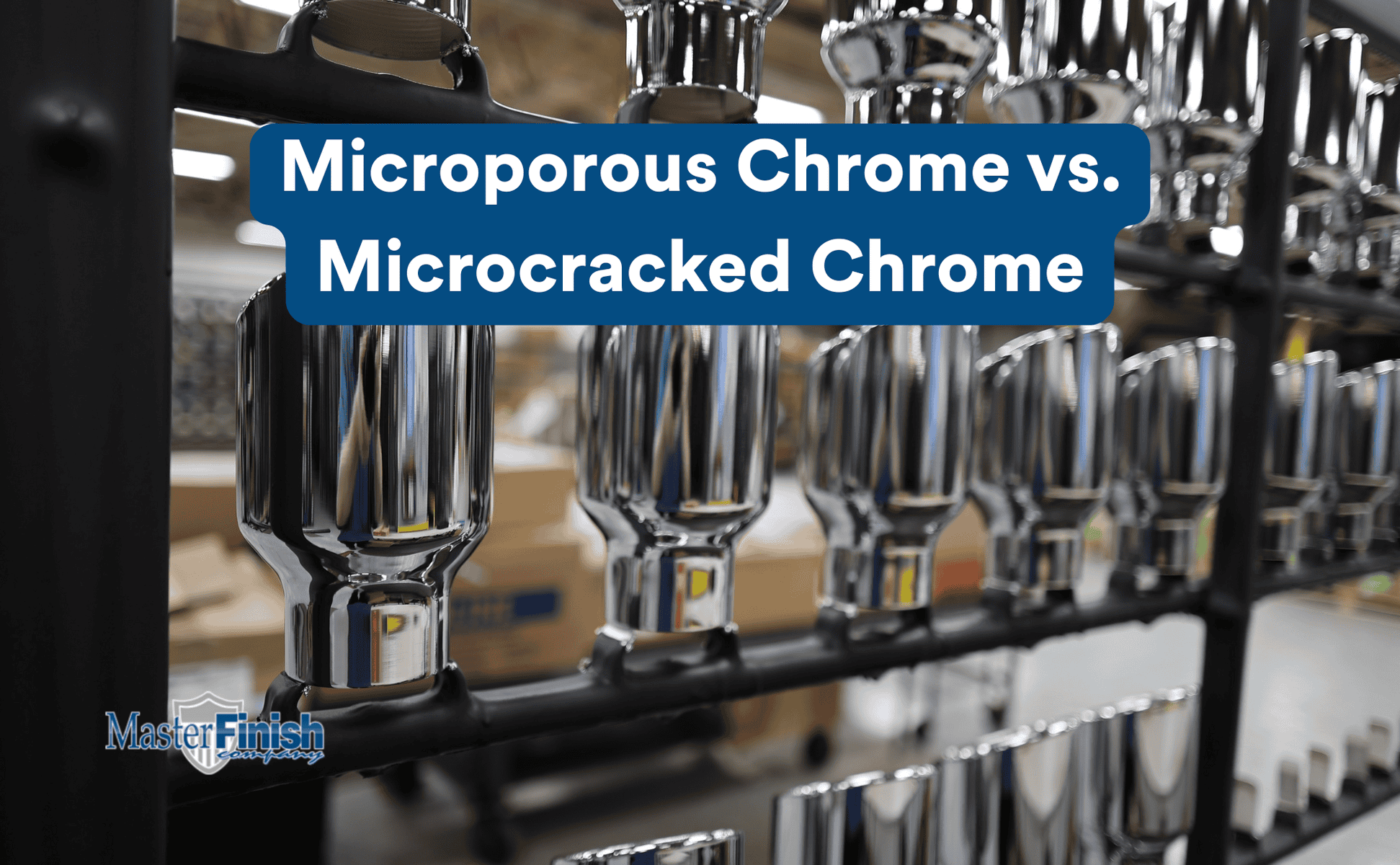
Master Finish offers microporous chrome plating to meet the evolving demands of today’s market. There’s a reason major OEMs—GM, Ford, Stellantis, and many others—are moving toward this technology. Below is a clear breakdown of why we choose microporous chrome over microcracked chrome for many of our decorative applications.
Microporous Chrome vs. Microcracked Chrome
When customers specify decorative chrome, they’re typically focused on three things:
- A consistent, high-quality finish
- Long-term corrosion protection
- Light abrasion resistance for everyday handling
Two technologies are widely used to achieve these goals: microcracked chrome and microporous chrome. While both use a thin decorative chromium layer over nickel, the way each finish is engineered—and the performance it delivers—are quite different.
Microcracked Chrome
What It Is
Microcracked chrome is created by applying a thin chromium layer—usually 5–10 microinches—under conditions that naturally generate a network of extremely fine cracks. These microcracks form due to internal stress during the plating process.
Why It’s Used
- The fine crack pattern helps spread corrosion across many small sites instead of allowing deep, localized pits.
- The cracks are invisible to the eye, so the finish stays bright and mirror-like.
- It provides solid, reliable protection for automotive, appliance, and consumer trim.
Key Benefits
- Excellent brightness and reflectivity
- Reliable, proven corrosion protection
- Cost-effective for high-volume work
- Stable and consistent in production
Microporous Chrome
What It Is
Microporous chrome is produced by embedding microscopic particles into the chrome layer. After plating, these particles create a dense, uniform field of tiny pores—far more numerous than the crack network in microcracked chrome.
Why It’s Preferred for Demanding Environments
- The pores act as anchor points for corrosion products, slowing the spread of corrosion significantly.
- This structure delivers superior corrosion resistance, especially in harsh environments like automotive exteriors, marine applications, and outdoor components.
- The pores are too small to affect appearance, so the finish retains its bright, high-gloss chrome look.
Key Benefits
- Significantly higher corrosion protection than microcracked chrome
- More uniform performance on complex part geometries
- Ideal for harsh or high-salt environments
Which One Performs Better?
Appearance
Both technologies maintain full decorative brilliance with no visible texture difference.
Corrosion Protection
Microporous chrome is the higher-performing option, especially for exterior or high-corrosion applications.
Wear & Handling
Both provide good abrasion resistance for normal use. Microporous chrome may offer a slight edge due to improved protection of the nickel layers beneath.
Cost & Processing
Microcracked chrome is typically more economical and simpler to apply.
Microporous chrome involves additional steps and a slightly higher cost—but delivers premium performance.
Summary: Choosing the Right Finish
For applications where corrosion protection is critical—automotive exterior trim, marine hardware, architectural components:
→ Microporous Chrome is the best choice.
For standard decorative parts that need excellent appearance and good protection at a lower cost—interior trim, appliance hardware:
→ Microcracked Chrome remains a dependable, economical option.
Both finishes deliver the classic chrome look; the right choice depends on the environmental conditions and the level of durability your product requires.